Friday, September 23, 2011

The Last Twelve Months

I've been tracking myself (or more accurately: my phone) with Google Latitude for a little over a year now. During that time I've been in (or at least passed through) six countries on four continents, traveling some 76,000 miles. Not bad. Here are the actual data points for August 2010 through August 2011 mapped out:


Now I wish I had figured out this geo-tracking thing earlier. When I have spare time, I'll try to import previous years based on geo-tagged photos.

One Country, Many Nations?

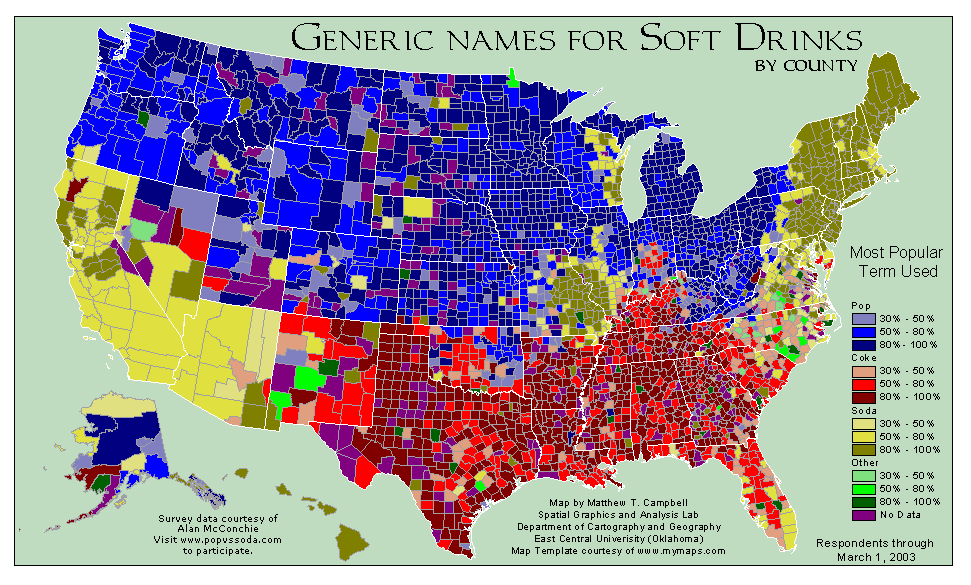
I read a post by Tobias Buckell this morning that got me thinking. It seems that when ever I get into a conversation with someone who is not from the USA, I run into the perception that the United States is a single homogeneous entity (and unfortunately, that perception is largely shaped by "Friends" and "The Simpsons"). It's difficult to fully convey how diverse my country really is: that the West Coast is not like the East Coast, that opinions can vary greatly between urban and rural areas, and that sometimes people who grew up in the same country speaking the same language can barely understand each other (I had a fun time listening to a guy from Boston try to talk with a guy from Louisiana a few years ago).

"Pop", "Soda", and "Coke" by county.
In a lot of ways, the US can be thought of as an empire made up of many different countries, unified by a common currency, over-arching federal laws, and television. Common currency allows easy trade between regions, federal laws work to promote equality throughout the country, and television enables cross-cultural pollination and keeps American English from fracturing into a dozen dialects. I'm sure this concept has been around for a long time. It was first clearly stated to me in Neil Gaiman's novel American Gods. And after living in Washington State, Michigan, and Texas, the "one country, many nations" idea rings true. Climate, architecture, accent, industry and fashion all showed significant differences between those three locations. I found this image of emerging "mega-regions" from the America 2050 site particularly interesting:

I really like the term "Cascadia" for the Pacific Northwest.
Tobias Buckell has a few more charts on his blog that are worth a look.

So this has all been interesting to think about, but are there any conclusions that can be drawn from this line of thought? Off the top of my head:
  • Television is important to the health of our identity as a single country.
  • High-Speed Rail proposals have a pretty close correlation to these mega-regions
  • In-country tourism should be strongly encouraged so Americans can really understand all that it means to be an "American".

Any other thoughts or ideas? Sound off in the comments!

Friday, September 16, 2011

Standing Desk Part II

Cornell University has weighed in on the standing vs. sitting at work debate. Their conclusion is that while standing is arguably better than sitting in terms of calories burned, standing alone isn't sufficient - actually moving about is required.

In my experience over several months of working at a standing desk, all their points ring true. Fine motor control (typing) definitely took a hit for awhile, and standing was definitely more tiring at first. But my typing while standing is nearly as fast now as it is when I'm sitting, and after the first week my feet stopped bothering me. One thing I think the Cornell study missed is that I am much more likely to move around - both in terms of shifting my feet and weight, and in walking down the hall to the printer or co-worker's office - than I was when I sat while I worked.

On a personal level, I've noticed a huge improvement in my posture since I started standing. I actually get uncomfortable when I slouch on the couch now.

Standing at work is not a silver bullet, and I've taken a LOT of crap from my co-workers for my crazy computer set-up, but it's accomplishing what I wanted it to: improving my posture and keeping me more alert at work.

Tuesday, September 6, 2011

Seattle

Took an unexpected trip up to Seattle over Labor Day weekend. Got to walk along a river, check out the state fair, attend a church potluck and hike a mountain. And spend some quality time with my family.


Thursday, August 11, 2011

NPR's Top 100 Science Fiction and Fantasy Books


NPR posted their top 100 science fiction and fantasy books and series today. It's a pretty good list, and it turns out I've only read 45 47 out of the hundred. Looks like I need to read some Kurt Vonnegut and Stephen King.

Hit the jump for the complete list, with the ones I've read in bold: 

Monday, August 8, 2011

Thursday, July 21, 2011

The Hobbit Production Video #3

Must see. I particularly liked the brief shot of the "big" dwarves right next to the "small" dwarves. Kinda like seeing double, but not.


Via The Hobbit Movie Blog.

Monday, July 18, 2011

The Dwarves of "The Hobbit"

Definitely not how I imagined, but pretty cool nonetheless.


from The One Ring, via Hobbit Movie Blog.

Tuesday, June 28, 2011

Standing Desk

I'm trying out this "Standing Desk" concept. For a thorough explanation of the concept, check out this article by Gina Trapani. My job has been pretty sedentary over the past several months (not that I mind being indoors and air conditioned during the 100+ degree weather we've been having here in west Texas) and my waistline has been responding as you'd expect. In addition, my sitting posture is terrible and this may help me avoid back problems down the road.


I picked up two 12" tall shelves from Lowes yesterday evening and assembled them during lunch. One is supporting the monitors and other has the keyboard and mouse. My coworkers think I'm nuts, but that's been true for a while now.

So, I'm expecting to have sore feet for the next several days, but by next week things will hopefully be feeling normal. We'll see how it goes.

Update: Standing Desk Part II

Monday, June 6, 2011

Cutting the Cable

Over the weekend, I hooked up my HTPC with a USB cable tuner and antenna. Without a CableCARD (and who wants to deal with that hassle?) the cable tuner was only able to access the analog cable channels. Since US broadcast television went digital in 2009, over-the-air signals are actually better quality (for me, anyway). I get ABC and Fox in HDTV, and about 15 other channels in standard def.

Now running Windows Media Center (which is pretty awesome, btw) on a Windows 7 box hooked up to the TV via HDMI, I can play movies, tv shows and music from my pre-existing libraries, throw up a picture slideshow, play and record live TV via terrestrial broadcast, use Apple's Airplay from my iPhone or iPad, and access Netflix and Hulu for internet TV content. All controlled by a single remote control.

As I'm not actually paying for cable myself (corporate perks!) I'll still use cable to get my Mythbuster's fix. But the next time I move, I suspect I'll forgo cable TV entirely.